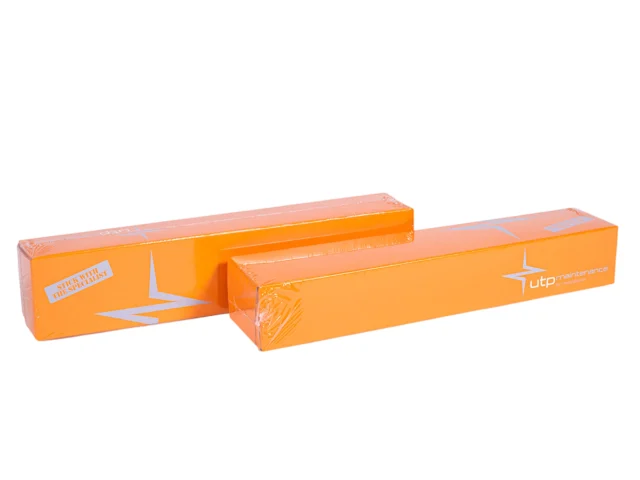
WEARstick MnCr4 is suitable for tough, crack resistant joints and surfacings on parts in high Mn steel subject to extreme impact, compression and shock, and build-ups on carbon steel are possible too. The main application is in construction, in quarries and in mines, surfacing worn high Mn steel parts such as excavator pins, buckets and teeth, mill hammers, crusher jaws and cones, rails, crossings and switches. Previously sold as UTP 7200.
The classification is EFeMn-C to AWS A5.13, E 7-UM-250-KP to DIN 8555 and E Z Fe9 to EN 14700. The high manganese content gives a fully austenitic deposit that hardens in service from 200 to 250 HB up to about 450 HB, and reaches 48 to 53 HRC once fully work hardened. Machining is possible with tungsten carbide tools. The electrode carries a DB approval under number 20.138.08.
- Classification DIN 8555: E 7-UM-250-KP, EN 14700: E Z Fe9
- AWS classification A5.13 / SFA-5.13: EFeMn-C
- Coating: basic
- Current: AC/DC+
- Diameters: 2.0 / 3.2 / 4.0 / 5.0 mm
- Lengths: 350 and 450 mm
- Hardness of deposit: 200-250 HB
- Approvals: DB (No. 20.138.08)
- Former name: UTP 7200
The worst mistake on Hadfield steel is overheating, so surface in sections, alternate the places you weld and let the part cool in the breaks. For larger losses use the 5.0 mm diameter in the flat position, and keep 2.0 mm for small edge repairs. After a bead is laid, peen the hot deposit with a hammer, that reduces the shrinkage stresses. Store the electrodes dry and dry them to the maker data sheet.