
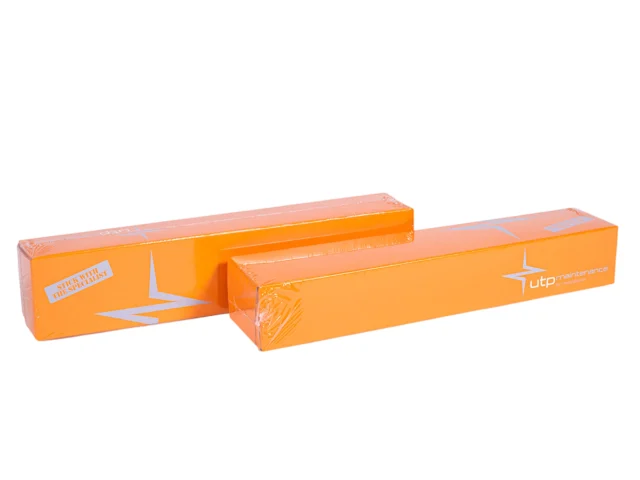
Start with the coating. A rutile electrode strikes easily, works on alternating and direct current, gives a smooth face and slag that lifts off readily, which is why it is the first choice for general work and thin sheet. A basic electrode gives the cleanest weld metal, with high impact toughness and low hydrogen content, and it is the electrode for load bearing structures, heavy sections and higher strength steels, but it has to be dried and it needs direct current on positive polarity. A cellulosic electrode welds vertical down and fuses the root, which is why it rules on pipelines.
You match the diameter to the material thickness and the current: 2.0 and 2.5 mm for sheet up to 4 mm, 3.2 mm for 4 to 8 mm, 4.0 and 5.0 mm for heavier sections and multi-run welds. The maker gives the current range in the data sheet, as a guide 30 to 40 A for every millimetre of core diameter.
Store basic electrodes somewhere dry and dry them as the maker's data sheet states, usually 2 hours at 300 to 350 degrees, and keep opened packs in an electrode quiver. Rutile and cellulosic electrodes do not need drying, but they do not like damp either. On stainless steels keep a short arc and do not overheat the joint, and in hardfacing pay attention to preheating and to the deposit hardness, which we give for every electrode.
If you are looking for an electrode under its old UTP name, for example UTP DUR 600 or UTP 65 D, type it into the search box and we will show you the current equivalent from the catalogue. Not sure what to choose for a particular joint? Call us, and a welding engineer will match the electrode to the material, the position and the machine.